


Red light therapy wearable devices are rapidly changing how active adults manage chronic pain, but finding one that truly delivers consistent, hands-free results while you move is harder than it looks. This guide cuts through hype to help you choose realistically, with a focus on flushed-to-skin dosing, mobile comfort, and total ownership costs. If you want proven pain relief on the go, not marketing claims, read on—here’s how to separate the real contenders from the clutter.
Key Takeaways
- Flushed skin contact and secure fit matter far more than sheer LED count for mobility and pain relief.
- Battery life, discomfort, and durability—not output specs—are the most frequent user complaints. Always calculate total cost beyond the device price.
- The best wearable red light therapy device for 2026 is one with proven specs, fit-tested comfort, and transparent warranty coverage—not just app features or brand recognition.
- Quick market snapshot and 2026 forecast
- Why “fit, contact, and movement” are the real clinical variables
- Top real-world pain points from user reviews
- Head-to-head technical spec checklist
- Product profiles — Kineon Move+, Lumaflex, and typical belts
- Price ranges and hidden ownership costs
- How clinical studies and expert reviews assess wearables vs panels
- 2024–2026 product innovations that improve hands-free usability
- Buying checklist — how to choose a wearable for daily activity
- Three deep-dive questions competitor articles usually miss
- Short recommended picks and use scenarios
- Quick FAQ
- Methodology and sources
Quick market snapshot and 2026 forecast
The global market for red light therapy devices reached about $936 million in 2024 and is forecast to top $1.0 billion in 2025, with steady growth anticipated through 2035 (source). The wearable red light therapy device 2026 market—specifically belts and modular units—outpaces this, valued at approximately $1.9 billion in 2026, and forecast to rise to $4.7 billion by 2034 (roughly 11.3% CAGR per DataIntelo). Red light therapy belts alone made up about $1.8 billion in 2025. Competition is intensifying as more vendors chase this “on-the-go therapy” segment, so buyers benefit from improved features, more transparent tech specs, and the pressure to innovate for comfort and battery life.

Why “fit, contact, and movement” are the real clinical variables
Most red light therapy wearable marketing pushes LED count, panel size, or fancy apps. In practice, direct skin contact and secure fit matter far more. Why? The inverse square law: Light’s intensity drops sharply with every millimeter of distance or shift, meaning output is much weaker if a wrap lifts off the skin—even slightly—during walking or activity (iReliev). Wearables that flex and stay flush deliver a reliable, repeatable dose to joints or muscles, regardless of body type or motion. Even the most expensive panel cannot match the contact-dosing advantage if you need mobile relief.
Top real-world pain points from user reviews
Across hundreds of reviews for every type of red light therapy patch wearable and RLT wearable for joints, the main complaints fall into four categories:
- Comfort: Bulky straps, hard edges, or poor adjustability dig into skin or impede movement, especially if you wear the device during errands or at a desk.
- Battery life: Most consumer wearables last only 2–4 hours per charge. For anything longer, be prepared for interrupted sessions—and note long recharging times or hard-to-source batteries.
- Effectiveness while moving: As you walk or reposition, many devices shift or lift off, which cuts light output and treatment consistency. “Flush” fit is non-negotiable.
- Durability and overheating: Repeated flexing can crack cheap LED boards or ribbon connectors; some units overheat, causing module failures or even skin irritation over time. Look for user reviews mentioning loss of irradiance or failed lights.
Watch out for return policies that make it hard to claim on these issues. If you see several mentions of the same flaw, it’s a real-world problem—not a one-off.
Head-to-head technical spec checklist (what to compare)
If a manufacturer can’t (or won’t) provide these specs for their wearable infrared light therapy belt, consider that a red flag:
- Wavelengths: Reputable devices use 630–850nm for optimal tissue relevance. Ask for the exact nanometer values for both red and NIR LEDs.
- Irradiance (mW/cm²): Should be measured on skin, with the device in actual use position, not in open air. Demand independent test data or request a spec sheet.
- Tissue penetration claims: Some products (e.g., Kineon Move+) claim up to 5–6 cm with NIR. Most independent experts remain skeptical of more than 2–4 cm real-world penetration—interrogate wild claims.
- Battery capacity/run time: Look for 2–4 hours minimum. Can the battery be swapped or replaced? How long does a recharge take?
- Weight and flexibility: Will it weigh you down? Can it fully curve or contour to the body part during motion?
- IP rating and warranty: IPX4 or better recommended for sweat resistance; check warranty for LED/module longevity and battery replacements.
- App/firmware: Are dose logs or timed cycles available? Which features require an ongoing subscription?
Specs manufacturers often omit: On-body irradiance during motion, true total weight, failure rate data, and evidence of long-term output retention. The smart move: Email support and demand actual measured mW/cm² on skin while moving—not in a lab stand.
Product profiles — Kineon Move+, Lumaflex body wrap, and typical infrared belts (quick comparison)
Below is a quick comparison of three leading device categories for active adult users:
| Product | Key Features | Pros | Cons / Issues | Best for |
|---|---|---|---|---|
| Kineon Move+ | Modular spot LEDs, 630nm + 810nm, 5–6 cm claimed NIR penetration, rechargeable; magnetic bands | Pinpoint, flush fit for joints/tendons; modules flex for movement; easy targeting | Some warmth/overheating risk; price premium; battery lasts 2–3 hours typical | Targeted joint pain, tendonitis, pinpoint use while walking/working |
| Lumaflex Body Wrap | Curved, flexible wrap; dual wavelengths; wireless operation; broader surface | Large muscle or back coverage; hands-free; easy fitting to multiple areas | Bulkier for small joints; can slip if not tightly secured; 2–4 hour battery typical | Larger muscle groups, lumbar/back, post-exercise recovery |
| Infrared Therapy Belt | Velcro/strap design; ~630–850nm; coverage for lumbar/abdomen; midrange price | Everyday lumbar/abdomen support; more affordable; good for daily office or desk use | Less flexibility; comfort varies a lot; overheating/durability issues in cheap models | Chronic back pain, hands-free lumbar support during activity |
Hardware trends: Both wearable red light therapy device 2026 models and newer belts increasingly use flexible wraps and rechargeable batteries for truly cordless, daily use.
Price ranges and hidden ownership costs (what to budget)
Upfront prices vary sharply:
- Entry Level: Basic red light therapy patch wearables from $99 to $249
- Mid-Range: Flexible belts and wraps $249 to $449
- Premium: Modular, programmable units (e.g., Kineon Move+, Lumaflex) $499 to $799+
That’s just the hardware—total ownership costs often surprise new buyers. You may also need:
- replacement adhesive patches or magnetic bands (every 3–6 months)
- Battery or charging cable replacements (out-of-warranty costs add up)
- Protective carrying sleeves or storage cases
- Mobile app subscriptions or firmware upgrades (some advanced dose-log features require extra fees)
- Shipping/returns for support or warranty (especially if buying outside your country)
Projection: Over 2–3 years, it’s not unusual to spend 30–50% over the device sticker price. To compare fairly, total up hardware, recurring consumables, and any “hidden” app/service fees before you buy—especially for wearable red light therapy device 2026 models with app-controlled dosing.
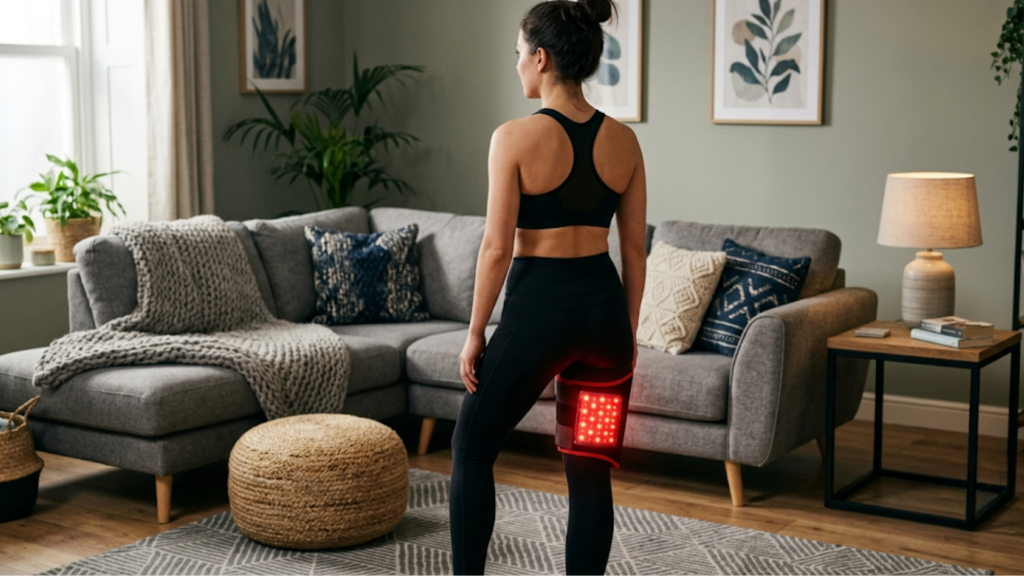
How clinical studies and expert reviews assess wearables vs stationary panels for joints/back
The honest evidence: For back and joint pain, panels work—but only while you sit or stand still. Most trials show clinically relevant pain relief is tied to total light absorbed by tissue, not the device type (ConsumerLab review). That said, wearable red light therapy patch and belt form-factors have a true mechanistic advantage if and only if they maintain flush-to-skin contact. This overcomes the “inverse square” loss seen with even powerful stationary panels. Both panels and wearables are rapidly gaining clinical credibility for at-home pain relief, but wearable dosing is less standardized and long-term outcome data (2+ years) is still emerging. Bottom line: If you move during therapy—or want to treat while working—wearables are next-gen, but scrutinize their specs and cycle out poor fitting models quickly.
2024–2026 product innovations that improve hands-free usability
Leading edge in this space is about hands-free, mobile ease—not just headline tech specs. Recent and upcoming innovations include:
- Modular clip-on modules (e.g., Kineon Move+), letting you adjust to knees, elbows, or ankles
- Highly flexible wraps that contour better to curved surfaces (Lumaflex, select 2026 belts)
- Proprietary adhesive/strap designs that resist shifting during exercise or daily chores
- Dual-wavelength arrays for simultaneous deep and surface tissue penetration
- App dose-tracking and automated treatment cycles with logs for each session (premium models)
- Enhanced battery management, with ultra-fast charging and “hot swap” battery packs
According to market studies, smart integrations and modular designs are rapidly becoming standard in wearable infrared light therapy belt products—expect rough edges to disappear by late 2026 models.
Buying checklist — how to choose a wearable for daily activity
Here’s a step-by-step buyer’s shortcut—use these priorities when evaluating a red light therapy wearable for pain:
- Confirm flush skin contact and secure fit (no slipping or gaps during movement)
- Get wavelength and on-skin irradiance specs (request lab-measured mW/cm² while moving)
- Evaluate battery runtime & recharge (look for 2+ hours; check charging time and battery replacement policy)
- Check modularity and adjustability for your target body part/area
- Assess IP rating and warranty (water/sweat resistance and solid warranty protecting both LEDs and battery)
- Calculate total cost of ownership over 2–3 years including all consumables and subscriptions
Three deep-dive questions competitor articles usually miss (and how to answer them)
- What’s the real delivered dose while moving? Light output may drop over 40% if the wearable flexes or lifts. How to check: Email for independent on-skin, in-motion irradiance or use a calibrated light meter on yourself if possible.
- How does the device hold up after 100+ sessions? Ask for any test data on output retention after repeated flexing—and check warranty small print for LED and battery module specifics. Some devices lose 20–50% irradiance in months if poorly designed.
- What will you actually spend over 2–3 years? Add up patches, batteries, required app fees, and replacement modules—not just headline price. Wise buyers get this in writing from sales support first.
Missing these questions is why so many first-time buyers get burned on durability, effectiveness, or ongoing costs—especially for a wearable red light therapy device 2026 model that seems affordable but requires many extras.
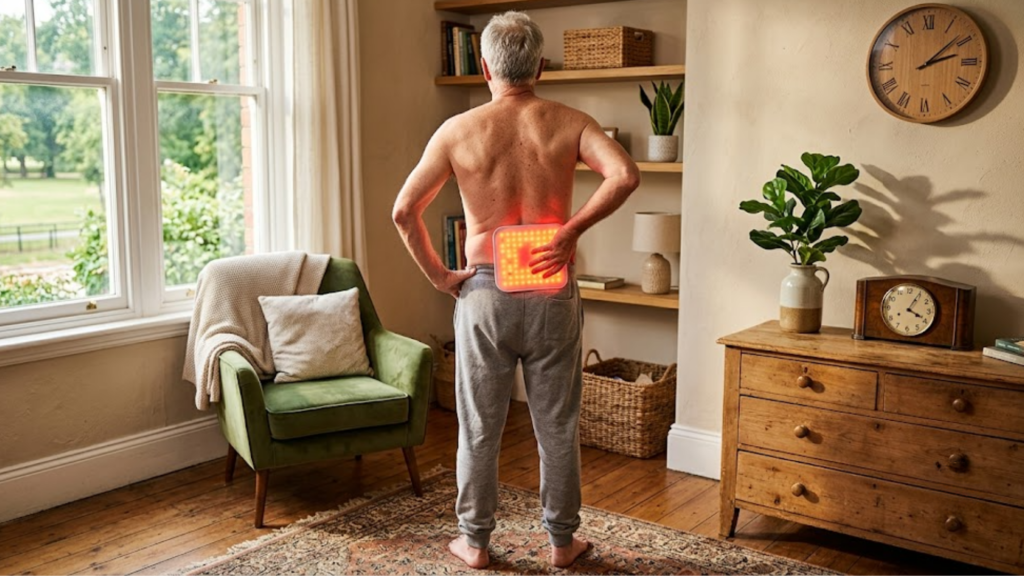
Short recommended picks and use scenarios (who should buy what)
The best device depends on your pain pattern and lifestyle. Here’s a rundown:
- Targeted, modular spot treatment: Kineon Move+ review—modular design fits knees, elbows, ankles best; portable for walking or working at a desk.
- Flexible body wrap: Lumaflex body wrap—covers wider areas like the back/thighs, ideal for active adults who prefer hands-free relief during home chores or stretching sessions.
- Daily lumbar/back belt: For office or chronic lumbar needs, a wearable infrared light therapy belt with secure straps may be ideal—watch for overheating complaints in budget models.
When to skip a wearable: If you’ll only treat in one spot and don’t need to move, a stationary panel (see panel comparison here) may be better value. For severe, unresponsive pain or unclear diagnosis, see a clinical provider first.
Both Kineon Move+ and Lumaflex are pushing the modular, mobile future for wearables, but there’s still a tradeoff on battery and long-term durability. Do not expect a $100 patch to provide years of daily use without issues.
Quick FAQ
Is a red light therapy wearable safe for daily use?
Yes, when used as directed and with quality devices. Mild heat or skin irritation from patches has been reported if straps are too tight or sessions are too long—test on a short session first and always read warranty/return terms.
Can I use a wearable during moderate exercise?
Most can be worn for walking or stretching, but avoid high-sweat or strenuous sessions unless rated IPX4 (sweat resistant) or higher. Bulky devices may shift and lose dosing effectiveness during intense movement.
How often does a wearable need charging?
Expect to recharge after 2–4 hours use (typical for quality models). Daily pain management usually means charging every night or buying a battery life with hot-swap or quick-charge as a priority.
Can the adhesive or strap cause skin irritation?
Some users report minor irritation after prolonged wear. Try shorter sessions first or rotate position on the body. Look for reviews mentioning comfort and always test the wearable’s fit right away.
How do I know a device’s clinical claims are real?
Ignore “miracle” cures; instead, demand on-skin, in-motion irradiance specs, a transparent warranty, and check for inclusion in independent reviews like ConsumerLab or GarageGymReviews.
Methodology and sources
Market and product data referenced from WiseGuyReports, DataIntelo, CoherentMarketInsights, and independent reviews at Garage Gym Reviews and ConsumerLab. For more detail or device verification checklist, email or download below. For in-depth device comparisons, see our guide: Red Light Therapy Device: 7 Amazing Ways To Achieve Proven Skin And Pain Relief.
Want to shop smart? Download the one-page device verification checklist (PDF) or compare 3 recommended models side-by-side now.