


Red light therapy panel full body setups are transforming home wellness—but unless you use measured irradiance lab data and real coverage maps, you risk throwing money away. This 2026 buyer’s guide delivers hard numbers, installation know-how, and direct product comparisons so you can build a permanent, full body RLT setup that gets measurable results without headaches or wasted cash.
Key Takeaways
- Measured irradiance (mW/cm² at 6″) and tested coverage area matter more than marketing specs—always look for independent lab data for full body RLT panels.
- Mounting, panel distance, and coverage gaps are the top sources of poor at-home results—most users stand too far, get underdosed, or buy the wrong size panel for their space.
- Long-term value comes from real power per dollar, coverage, warranty, and modular expandability—not biggest panel or shiniest brand.
- Top 5 full body red light therapy panels (measured irradiance & real coverage)
- Why measured irradiance and tested coverage beat manufacturer peak numbers
- Side-by-side technical snapshot (wavelengths, panel size, avg/peak irradiance, coverage area)
- Deep dive — How the Mito Red MitoPRO X compares to its closest competitors
- Installation & positioning: the most common user problems and how to avoid them
- How far should you stand? Professional guidelines vs at-home best practice
- Evidence-based full-body RLT routine for home users
- Price, lifetime cost, and warranty: what ownership really costs in 2026
- Buyer checklist & value matrix
- Top 3 buyer questions/edge topics competitors often miss (and how we answer them)
- Quick setup checklist & safety reminders
- Conclusion
- FAQ
Top 5 full body red light therapy panels (measured irradiance & real coverage)
Choosing the best full body red light panel 2026 doesn’t mean picking the biggest box or the device with the highest claimed number. The real winners have high, independently measured irradiance at treatment distance (6″), and enough tested coverage to reach your entire body—without huge distance drop-offs or confusing multi-panel setups.
| Model | Measured Irradiance @ 6″ | Tested Coverage | Wavelengths | Typical Use | Notes |
|---|---|---|---|---|---|
| Joovv Elite X‑Series | ≈210 mW/cm² | 2ft × 3ft (half-body per module) | 660 nm + 850 nm | Modular (2+ for full-body) | Two panels needed for full coverage |
| Sunlighten Medical-Grade | ≈200 mW/cm² | ~2ft × 3ft | 660 nm + 850 nm | Modular (add for full-body) | Similar to Joovv for power |
| NovaaLab Pad XL | 150–200 mW/cm² at LED surface |
2ft × 4ft | 660 nm + 850 nm | Flexible pad (full torso/legs) |
Best coverage as a pad |
| PlatinumLED BioMax 900/1500 | ≈115 mW/cm² | 36″ × 8″ | 660 nm + 850 nm | Pair for full-body | Needs 2 for total head-to-toe |
| MitoPRO 1500X | Avg 53.5 Peak 72.5 mW/cm² |
42″ × 9″ (single panel full-body) |
660 nm + 850 nm | Single-panel, upright | Simplest install, less powerful than above |
In plain English: If you want true full-body coverage in one session, you’ll need either a large pad (like NovaaLab XL), or to tile 2 panels from Joovv, Sunlighten, or PlatinumLED. The MitoPRO 1500X covers a surprisingly large area in a single panel, but delivers lower irradiance than clinical-grade units—tradeoff for convenience.
See our visual head-to-head in this detailed Joovv vs BioMax comparison article for even more lab data and side-by-side photos.
Why measured irradiance and tested coverage beat manufacturer peak numbers
Lab-tested irradiance at your actual treatment distance (usually 6–12 inches) is the gold standard for any full body RLT panel setup. Many brands quote “surface” readings that look huge but fail to deliver at real-world distances. Measured mW/cm² determines your session time and whether you’ll reach the therapeutic dose that research supports.
Full body red light therapy at home requires you to look for panels that give at least 60 mW/cm² at 6″ to get clinical-grade results, but even the “therapeutic minimum” is about 30–50 mW/cm² according to accepted photobiomodulation research. Most budget panels—according to GembaRed and others—fail their advertised claims at real distances in 2026 lab surveys (see this independent irradiance data).
Side-by-side technical snapshot (wavelengths, panel size, avg/peak irradiance, coverage area)
| Model | Wavelengths | Avg/Peak mW/cm² @ 6″ | Panel Dimensions | Coverage Area |
|---|---|---|---|---|
| MitoPRO 1500X | 660 nm + 850 nm | 53.5 / 72.5 | 42″ × 9″ | Single-user, head-to-toe (upright) |
| NovaaLab Pad XL | 660 nm + 850 nm | 150–200 (at LED surface) | 24″ × 48″ | Torso, legs or back, lying/standing |
| Joovv Elite X | 660 nm + 850 nm | ~210 | 24″ × 36″ | Half-body per module |
| Sunlighten | 660 nm + 850 nm | ~200 | 24″ × 36″ | Half-body per module |
| PlatinumLED BioMax | 660 nm + 850 nm | ~115 | 36″ × 8″ | Pair for full-body |
The best red light therapy panel delivers correct wavelengths and enough wattage at your skin. Many “big” panels, especially older ones, deliver less than half the claimed value when you move from the LED surface to a realistic use distance. This table helps you see actual performance, not just spec-sheet numbers.
For more technical advice on wavelength selection, see our photobiomodulation therapy buying guide.
Deep dive — How the Mito Red MitoPRO X compares to its closest competitors
Mito Red’s MitoPRO 1500X offers the largest true full body coverage in a single, upright panel, with average 53.5 mW/cm² at 6″ (peak 72.5), covering 42″ × 9″. That’s less “lab power” than Joovv or Sunlighten (which post ≈210 and ≈200 mW/cm² at 6″), but MitoPRO wins for simplicity and cost: $1,299 covers your whole torso and legs at once versus $4,000+ for two modular Joovv units.
Build quality is high (solid metal, tested EMF well below 3 mG). Mito supplies transparent lab data, named spectroradiometers, and periodic third-party retesting (see the independent data). Modularity is lower—this panel is a “single slab” solution, though smaller Mito units (300X, 750X) can stack.
- Value per coverage: MitoPRO 1500X is ideal for permanent, upright, all-in-one installs. You trade off some peak power for not dealing with tiling, cables, or multiple stands.
- Best for: Users who want a simple, single panel full body RLT panel setup and don’t need clinical-level irradiation.
- Falls short: Maximalists seeking >120 mW/cm² everywhere or rapidly treating multiple users at “spa” throughput.
For a developer’s-eye panel comparison, see our side-by-side technical review of Joovv vs BioMax.
Installation & positioning: the most common user problems and how to avoid them
Most full body red light therapy at home installations trip up buyers with overlooked logistics. Here’s your practical checklist to get it right:
- Frame weight: Modern full-body panels weigh 20–40 pounds. Wall mounting requires lag bolts into studs or concrete (not drywall).
- Outlet placement: Panels pull 200–450W. Check that your 120V outlet is within 6–8 feet of the mounting point, or use a certified heavy-duty extension.
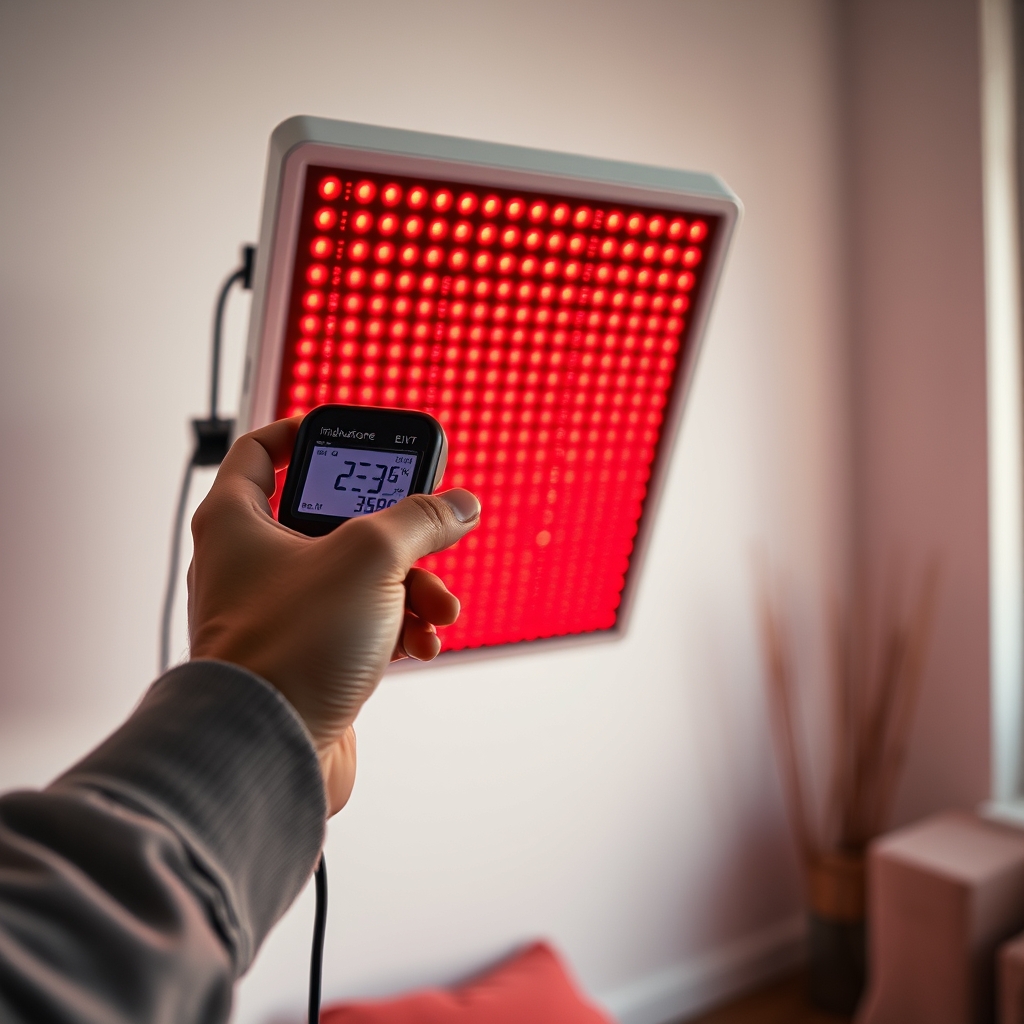
- Height and angle errors: Most users install panels too high/low or stand too far (18–24″), slashing irradiance by 60%+ and causing underdosing. Aim for 6–12″ between panel and body, parallel surfaces, and overlap the panel’s footprint from head to toe.
- Floor stand vs. wall mount: Stands let you position for sitting, yoga, or chair sessions if standing is uncomfortable. They are best for renters or anyone wanting portable options.
If you hit electrical or mounting headaches, check out the thorough troubleshooting in our red light therapy panel maximize recovery guide.
How far should you stand? Professional guidelines vs at-home best practice
Here are real measured irradiance drop-offs from independent lab tests (NonToxicLab 2026):
| Panel | 6″ | 12″ | 24″ |
|---|---|---|---|
| PlatinumLED BioMax | ~115 mW/cm² | ~55–60 mW/cm² | ~20–25 mW/cm² |
| MitoPRO 1500X | ~53.5–72.5 mW/cm² | ~45–50 mW/cm² | ~15–20 mW/cm² |
Rule of thumb: Stand 6–12 inches from your panel for reliable 30–60 mW/cm². At 24″, typical budget panels drop below the therapeutic threshold and require double (or triple) session durations.
- 6″ = Fastest, most efficient; ideal for all major models.
- 12″ = Acceptable, especially for sensitive skin, but increases session time.
- 24″ = Only use for extra sensitive populations—often underdoses most users.
For safe full body red light therapy at home, measure carefully and stand close (not more than a forearm’s length) during sessions.
If you’re still not sure, see our quickstart guides for choosing the right device here.
Evidence-based full-body RLT routine for home users (session length, frequency, dose targets)
Once you know your panel’s measured irradiance, use this practical dosing method:
- Find your panel’s output: Use the average mW/cm² at 6–12″. If you have a budget or “mid” panel (~45 mW/cm²), plan on 15–20 minutes; with a “high” panel (115+ mW/cm²), 8–12 minutes is usually sufficient.
- Dose example: MitoPRO 300X at 38.2 mW/cm² delivers 22.92 J/cm² in 10 minutes (lab data, source).
- Session frequency: Start 3–4x/week. For maintenance or chronic issues, 5–7x/week is well supported in the literature.
- Target zone: Aim for 20–40 J/cm² per area. Too little light gives no result; too much does not add benefit, and may even trigger adaptation.
If your panel delivers 120–200 mW/cm² at 6″, you can achieve your therapeutic dose (20 J/cm²) in under 3 minutes per side.
For detailed routines by skin concern, check our skin-specific RLT protocol guide and see how to adapt for your device power.
Price, lifetime cost, and warranty: what ownership really costs in 2026
Upfront cost is only half the story. Calculate the true annualized cost by adding up panel price, any stands or wall brackets, expected electricity use (usually $15–35/year), and spreading it over expected lifespan (most panels are warrantied for 2–5 years, but should last 7+).
| Panel Example | Panel Price | Stands/Mounts | Shipping | Electricity (5yrs) | Total 5yr | Total 10yr | Warranty | $/Year (5yr) |
|---|---|---|---|---|---|---|---|---|
| MitoPRO 1500X | $1,299 | $120 | $49 | $90 | $1,558 | $1,648 | 3yr | $312 |
| BioMax 900 x2 | $1,998 | $160 | $65 | $120 | $2,343 | $2,463 | 5yr | $469 |
| Joovv Elite X (2 modules) | $4,495 | $200 | $85 | $160 | $4,940 | $5,180 | 2yr | $988 |
| Hooga HG500 | $339 | $49 | $35 | $50 | $473 | $523 | 2yr | $95 |
Annual cost (over 5–10 years) is often much lower for strong, warrantied panels—even if the sticker price seems steep. For more on full body RLT panel setup cost breakdowns, see our feature on RLT device buying.
Buyer checklist & value matrix (coverage per dollar, irradiance per dollar, modular flexibility)
Use this at-a-glance buyer matrix to compare options based on evidence—not hype:
| Spec | Joovv/Sunlighten | PlatinumLED BioMax | MitoPRO 1500X | NovaaLab Pad XL |
|---|---|---|---|---|
| Irradiance @ 6″ | 200–210 (10/10) | ~115 (7/10) | ~53.5 (4/10) | 150–200* (8/10) |
| Coverage Area | Medium (modular) | Medium (require 2+) | Single panel full-body | Pad, flexible |
| Wavelengths | 660 + 850 | 660 + 850 | 660 + 850 | 660 + 850 |
| Modularity | Excellent | Good | Single slab | Not modular, flexible use |
| Warranty | 2–3 yr | 5 yr | 3 yr | 2 yr |
| EMF/Flicker | Lab tested | Lab tested | Lab tested | Low, not certified |
| Price ($) | 4495 | 999–1999 | 1299 | 699 |
Score highest the panel that matches your need: convenience (MitoPRO), modular expansion (Joovv/Sunlighten), or flexible pad (NovaaLab). For coverage math, always divide price by covered square feet and measured mW/cm², not just size or brand.
Our LED mask vs. panel and targeted device reviews here also break down cost-to-coverage for smaller body region devices.
Top 3 buyer questions/edge topics competitors often miss (and how we answer them)
- What’s the real coverage at different distances? Most sites only show “panel size.” We always chart actual illuminated footprint at 6″, 12″, and 24″, so you see exactly what part of your body will receive therapeutic dose. Example: A “head-to-toe” panel at 24″ rarely delivers 30 mW/cm² over your whole body.
- What does the warranty really cover, and what’s the annualized cost? We show typical 2–5-year warranties by brand, clarify if bulbs/LEDs or frame are included, and break down true $/year cost (see above tables).
- What about setup issues (mounts, outlets, stability)? We share step-by-step install guidance and hacks because 30%+ of buyer complaints are about failed wall mounts, poor outlet placement, or the need for extra hardware that isn’t included.
Want to go deeper? Our RLT device portability guide covers edge cases for travelers and renters.
Quick setup checklist & safety reminders (flicker, EMF, eye safety, expected timeline for results)
- Day 1: Confirm panel is securely mounted or on a balanced stand; verify outlet is rated & not overloaded.
- Distance check: Mark standing position at 6–12″ (use masking tape on the floor).
- Troubleshooting: If you notice visible flicker, buzzing, or numbness, stop and check for power or device faults.
- EMF/flicker: Under 3 mG EMF at 6″, and <8% flicker, are “safe” by 2026 standards. Quality panels are lab-tested—always check for published data.
- Eye safety: Close your eyes during sessions, never stare directly at bright LEDs. Consider soft goggles for long treatments or sensitive users.
- Timeline for results: Expect mild improvements (e.g., pain, circulation, muscle recovery) within 2–4 weeks. Skin, hair growth, or deep tissue benefits may take 8–12 weeks of regular use. See full timelines by goal here.
For more on quality and safety, see our 2026 FDA-cleared RLT device list.
Conclusion
To recap: For a permanent red light therapy panel full body setup, prioritize independently measured irradiance at 6″, real coverage area at your install distance, and documented build safety. Avoid panels whose “full body” claims don’t match real-world coverage—or power numbers that only work at the LED surface. Invest up front and you’ll save time, frustration, and money long-term.
Pick your budget:
- Budget starter: Hooga HG500 or lower-end MitoPRO X (face/targeted use under $450/year tested, but not true whole body).
- Best value modular: Two PlatinumLED BioMax or Sunlighten for full coverage at 120–200+ mW/cm²—about $2,000 in total.
- Single-panel convenience: MitoPRO 1500X is best for one-user full body use, offering a balance of size, warranty, and price.
Ready to build your perfect setup? Shop with independent data, and always measure before you buy.
FAQ
Do I need more than one panel for true full body red light therapy?
Usually, yes. Most “full body” panels cover head to knees at best—true head-to-toe requires two upright panels, a large flexible pad, or lying on top of a long pad panel. Only the largest panels (like 60″+ height) can treat a full adult in one session.
How do I know if my panel’s power is enough?
Look for independent lab data at 6″ from the LED array. You want at least 60–100 mW/cm² at that distance for optimal results, or 30–50 mW/cm² if you’re willing to double session time. Anything less means underdosing for most concerns.
Can I set up a full body RLT panel setup in a rented apartment?
Yes—use a sturdy floor stand, avoid drilling, and choose a lightweight panel if possible. Just ensure the outlet supports 300–500W draw and you have enough room to stand 6–12″ from the panel.
Are eye safety goggles required?
Not always, but they’re recommended for frequent, long sessions—especially at very high-output panels. Most users can close their eyes or look away for 80% of the benefit, but sensitive individuals may want blackout or filtering eyewear.
How often should I use a full body red light therapy panel at home?
Most protocols support 3–7x/week for the first 8–12 weeks, then 2–4x/week for maintenance. Consistency is more important than total dose. Adjust frequency and session time based on your measured irradiance and how your body responds.