


Portable red light therapy device sales are booming as travelers demand lightweight, evidence-based wellness gear they can pack into any suitcase without compromise. If you want reliable recovery or skin therapy on the move, understanding exactly what to look for in a portable red light therapy wand can save you money—and headaches—on your next trip.
Key Takeaways
- Handheld travel red light therapy devices deliver clinically relevant results when you choose the right specs—look for dual 660/850 nm wavelengths, at least 30–50 mW/cm² irradiance, and lightweight, durable construction.
- User pain points most often involve poor battery reliability, bulky size, and confusing features—always prioritize certified models with solid warranties for travel.
- Hidden travel costs add up quickly: budget for chargers, adapters, and extras to ensure your portable red light therapy device works wherever you land.
- Why portable red light therapy devices are the travel trend now
- Common traveler pain points & negative reviews to watch for
- Travel-ready technical checklist — which specs actually matter
- How portable devices compare to professional/full‑size units (efficacy & realistic expectations)
- Price range and hidden travel costs to budget for
- Safety, certifications and travel compliance checklist
- Practical on‑the‑go protocol — using a handheld effectively while traveling
- Quick decision matrix — how to choose the best handheld for travel
- Example shortlist & what each model excels at
- Three important sub‑topics top competitor articles usually miss
- Conclusion & one‑sentence buyer action
- Frequently Asked Questions
Why portable red light therapy devices are the travel trend now
As the global light therapy market soars past $800 million by 2031, the spotlight is on travel red light therapy solutions. Miniaturization and engineering advances mean a portable red light therapy device now offers nearly the same benefits as bulkier panels—making them the new staple for frequent flyers keen on workout recovery, skin health, or chronic pain relief. In fact, handheld units are projected to reach $958 million in 2025, accounting for about 34% of all sales and growing at an 8–10% annual rate.[1] Travelers care because each new generation of compact, battery-powered wands delivers stronger, more clinically relevant light in a carry-on friendly package—so evidence-based on-the-go care is finally possible, not just a marketing promise.
Common traveler pain points & negative reviews to watch for
Not all red light therapy devices for travel live up to the hype. The most-frequent pain points cited in reviews include:
- Unreliable battery charging or rapid battery failure—leaving travelers stranded or forced to hunt for spare power mid-trip.
- Durability issues from drops or pressure in luggage—some cases lack real protection.
- Bulky size/weight—if your portable red light therapy wand is too big, it’ll end up left behind.
- Skin irritation or “bumps”—especially from hard-pressed LEDs on sensitive faces or joints.
- Divisive vibration/noise features—nice at home, but surprising (and sometimes embarrassing) in hotels or planes.[2]
Look for models with proven track records specifically flagged as both compact and robust in independent reviews. Choosing a red light therapy device for travel that skips unneeded bells-and-whistles and prioritizes the above feedback can avoid most headaches.
Travel-ready technical checklist — which specs actually matter
Instead of chasing flashy features, prioritize the handful of portable red light therapy device specs that really matter for travel:
- Wavelengths: You want dual wavelengths—660 nm red for skin and 850–870 nm near-infrared for deeper recovery. This covers both skin and muscle/joint uses.
- Irradiance / Power Density: Top handheld RLT devices deliver at least 30–50 mW/cm² on target. Anything less may not reach clinical benefits.
- Session Length & Auto-Timers: 3–5 minute presets with auto-shutoff protect both your schedule and skin (and prevent battery drain in your bag).
- Battery Life: Look for 10–20 sessions per charge (equals 1–2 hours continuous)—critical for multi-day travel.
- Size & Weight: Ideal travel models land near 5 × 2 inches, 0.3–0.5 lb.
The best handheld red light therapy units hit at least ~49 mW/cm², dual wavelength, sub-half-pound benchmarks, and reliable session timers. See clinician reviews for specs-backed picks.
For additional deep-dive, check out Red Light Therapy Device: 7 Amazing Ways To Achieve Proven Skin And Pain Relief for more on next-gen specs and protocols.
How portable devices compare to professional/full‑size units (efficacy & realistic expectations)
A portable red light therapy device can now match the core clinical irradiance delivered by many large panels—but with a smaller treatment zone and reduced total coverage. For targeted pain relief, facial skin treatments, or spot muscle recovery, travel devices excel. If you need whole-body benefits (like for athletic recovery or widespread anti-aging), full-size panels still outperform for dose and convenience.[3] Notably, baseline brands like Tendlite built clinical credibility for portables, and reviewer favorites like the Gleam Mini now deliver up to 50 mW/cm² in palm-sized formats. For most travelers, the performance gap is minimal for face, joints, or spot pain—but be realistic with expectations and session planning.
If you want to compare panel and portable therapy, read this Red Light Therapy Panel 2026 buying guide.
Price range and hidden travel costs to budget for
Expect to pay $200–$400 for a high-quality, portable red light therapy device for travel. Market-leading wands like the Bon Charge Mini retail near $299, while premium full-size panels (for context) often start at $659.[4] Don’t forget hidden travel costs:
- Charger and international plug kit ($15–$40)
- Power bank for recharging on the go ($30–$80)
- protective carry case or sleeve ($20–$60)
- Replacement LEDs or lens caps ($10–$30)
- Premium warranty or service plans ($15–$50/year; vital for frequent travelers)
This investment is modest compared to lost wellness days from missed sessions or a failed unit abroad. You might also want to check if your device is HSA eligible to save more.
Safety, certifications and travel compliance checklist
Safety isn’t just about the therapy—it’s about protecting your gear and staying airport compliant. Look for these certifications:
- FDA Clearance/Approval: Proven medical claims and robustness for US flyers
- CE/FCC, RoHS: Compliance for Europe/Asia travel
- Lithium Battery Limits: Most airlines cap at 100 Wh per device—check device/battery specs
- Warranty/International Support: Critical for repair or replacement when abroad
Comparative device tables such as those found in clinician reviews or the FDA Cleared Red Light Therapy Device guide track FDA status. Always pack your portable red light therapy device and accessories in carry-on, not checked luggage.
Practical on‑the‑go protocol — using a handheld effectively while traveling
When your fitness, skin, or recovery algorithm relies on a travel red light therapy device, efficiency is key. Use this proven workflow:
- Charge your device every night or between uses using a universal travel adapter.
- Wipe the LED surface with a soft cloth or alcohol wipe to avoid skin irritation.
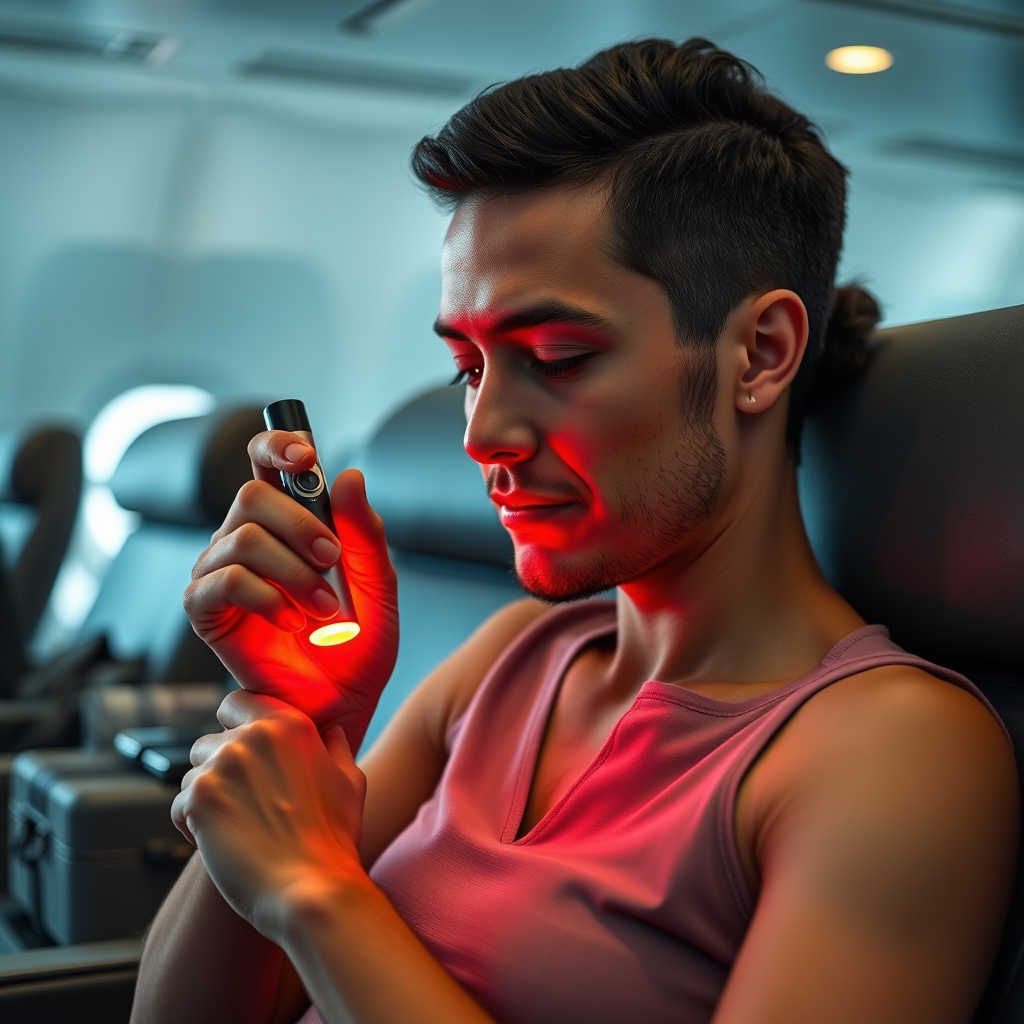
- Set auto-timer for a 3–5 minute session; hold about 1–2 cm from skin without pressing—or use the magnetic stand if provided.
- Repeat on other target areas as needed, tracking battery so you don’t run out mid-routine.
- Clean and stow in a padded case before repacking.
Typical battery life—10–20 sessions per charge—covers up to a week of daily use for most portable red light therapy wands.[5] Adjust session count if sharing devices with a partner or for multi-zone treatments.
Want more protocols for skin-focused red light routines? See our practical guide.
Quick decision matrix — how to choose the best handheld for travel
To quickly narrow your portable red light therapy device options, use this evidence-based matrix:
| Must-Have Spec | Why It Matters | Target Value (Travel) | Supports (Use Case) |
|---|---|---|---|
| Dual 660/850 nm LEDs | Maximum tissue penetration for skin & pain | Both wavelengths | Skin & joint recovery |
| Irradiance | Delivers true therapeutic dose | ≥ 30–50 mW/cm² | All use cases |
| Auto-timer (3–5 min) | Prevents overuse, saves battery | Yes | Face/spot-treatments |
| Weight | Won’t burden travel bag | < 0.5 lb | All |
| Battery life | Reliable sessions per charge | 10–20 sessions | Multi-day travel |
| Warranty | Protects investment | ≥ 1 year, international accepted | Frequent travel |
For more advanced comparisons or to troubleshoot between panels and handhelds, see our Photobiomodulation Therapy buying guide.
Example shortlist & what each model excels at (short bullets)
- Gleam Mini: Dual wavelength, ultra-light, FDA-cleared, best battery for daily use. Slightly premium price; magnetic stand is a travel plus.
- Joovv Go: Compact and powerful, well-reviewed for muscle recovery; auto-timer and USB-C charging. Some complaints of durability issues.
- LightStim Handheld: Proven clinical power; real user evidence for skin and pain. Vibration setting is divisive, and some find it bulky for long trips.
- Tendlite: Early leader in portable red light therapy; strong clinical backup, single-wavelength but reliable battery and compact build.
For face-first use cases, see our expert LED light therapy mask guide for mask options with similar travel credentials.
Three important sub‑topics top competitor articles usually miss
Most guides forget these actionable, travel-critical details:
- Airline & lithium battery logistics + international adapters: Airlines limit lithium battery sizes; always verify your device stays under 100 Wh and pack in carry-on. Bring a universal adapter for global travel. Read your airline’s current rules before flying.
- Session planning for small-area coverage: Travel dosing isn’t the same as home use—use a daily micro-protocol (several 3-minute treatments, distributed AM/PM) to reach cumulative effects over a week. This keeps up results even if you move locations frequently.
- International warranty/service workflow: If your portable red light therapy device fails while abroad, know the repair/replacement process and whether your warranty is valid internationally. Choose brands with clear global support.
This aligns with the wave of miniaturization and adoption—handhelds are a $958M category and still growing, so these operational tips are more crucial than ever.[6]
Conclusion & one‑sentence buyer action
The best portable red light therapy device for travelers is the lightest dual-wavelength model that meets credible power density specs, carries reputable certifications, and comes with a true travel-ready warranty. The segment is now enormous—handheld units represent nearly $1 billion in 2025, and demand is only rising.[7] Run the quick decision matrix above, shortlist 2–3 devices, and give yourself the certainty of evidence-backed results on every trip with a portable red light therapy device now built for the realities of modern travel.
Frequently Asked Questions
What makes a portable red light therapy device “travel-ready”?
Must-have features include dual 660/850nm LEDs, at least 30–50 mW/cm² irradiance, reliable battery (10–20 sessions per charge), a weight under 0.5 lb, sturdy build/shell, and international certifications.
Can I take a portable red light therapy device on a plane?
Yes, as long as the battery is under 100 Wh and you carry it on. Check airline rules for lithium electronics and pack a universal charger for overseas trips.
How do I avoid skin irritation when using a red light therapy device for travel?
Keep the device slightly above the skin (not pressed), use session timers, clean LEDs after each use, and wipe your skin before treating. Sensitive areas (like under-eye) may need extra care.
Are travel red light therapy wands as effective as large panels?
For small areas (face, joints, single muscle groups), yes—as long as the device meets true therapeutic specs. For whole-body use, panels deliver more total dose and convenience.
What extras should I pack with my device?
Bring the charger, international adapter, and a padded case. Extras like lens caps or wipes help keep it clean and ready for use anywhere.