


Red light therapy for pain relief is gaining serious attention as an at-home option for arthritis and joint pain, but does the clinical evidence match up to the promises seen in device ads? Here’s an unfiltered, actionable guide for people like Linda—if you want pain relief from red or near-infrared light, it’s crucial to know exactly what works, why at-home results often disappoint, and how to optimize your investment and outcome with real-world protocols.
Key Takeaways
- Clinical evidence supports temporary, moderate pain relief from red and near-infrared light for arthritis and chronic joint pain—but benefits require ongoing, consistent use at therapeutic doses.
- Most at-home devices underdeliver compared to clinic models due to weaker output, poor instructions, and tricky placement—optimizing specs and technique is essential.
- For best results: pick devices that specify proven wavelengths and irradiance, follow dosing protocols used in trials (8–12 minutes, 3–5 times weekly), and track your results over several weeks.
- What the latest clinical research (2022–2024) actually shows
- Why at-home devices often underperform vs. clinic devices
- Technical specs that determine effectiveness
- Practical treatment protocols — real home dosing and realistic expectations
- How to choose an at-home device (buyer’s checklist)
- Real-world user problems and step-by-step troubleshooting
- Costs, insurance, and long-term cost of ownership
- Safety, side effects, contraindications, and long-term considerations
- Top 3 sub-topics competitors often miss (and how we’ll cover them)
- Conclusion
- FAQ
What the latest clinical research (2022–2024) actually shows
For Linda and others seeking red light therapy for pain relief, several robust clinical studies and meta-analyses from 2022 to 2024 provide concrete evidence for its use in chronic musculoskeletal pain—including arthritis, knee osteoarthritis, and chronic low back pain. Randomized trials consistently report:
- Pain relief: 40–70% reductions in joint pain scores for people with rheumatoid arthritis or knee osteoarthritis, measured by validated pain inventories (source, WebMD).
- Morning stiffness: 20–30 minute decreases in morning stiffness, a meaningful difference for quality of life.
- Back pain: Reductions in pain intensity after three to five 10-minute sessions per week, with effects generally best for short-term relief (Omnilux).
- Temporary benefits: Most improvements require ongoing, regular sessions to maintain effect—the pain relief is not permanent.
Trials show the best outcomes when wavelengths of 630–660 nanometers (red) and 810–850 nanometers (near-infrared) are delivered at irradiances of at least 30 mW/cm², with an effective session length of 8–12 minutes per site, repeated three to five times per week (reference).

In summary, science supports red light therapy for arthritis and joint pain when you match the clinical protocols—but the benefits usually last only days to weeks after stopping regular use.
Why at-home devices often underperform vs. clinic devices
Despite the strong research, the real-world gap appears when people buy home devices expecting the same outcome as in a trial or clinic. Here’s why home infrared light therapy for joint pain frequently disappoints:
- Low power: Most consumer devices deliver weaker output (irradiance) than clinical systems. Results are much less pronounced.
- Loss of output: LEDs and batteries degrade, meaning devices can lose power over time—often without any notification to the user.
- Placement struggles: Getting a device positioned optimally on a knee or low back is tricky and time-consuming, especially for areas like the knee with curves or hard-to-reach spots.
- Instructions and adherence: Many devices provide unclear or overly technical instructions. Sessions get skipped, or incorrect placement/dosing reduces benefits (Cleveland Clinic).
- Adverse sensations: Overheating, skin irritation, or minor swelling are sometimes reported—especially if you double-treat or use multiple pads/panels at once.
- Short battery life: Short battery life: Battery devices may not last for multiple treatment sites or may recharge slowly, disrupting protocol adherence.
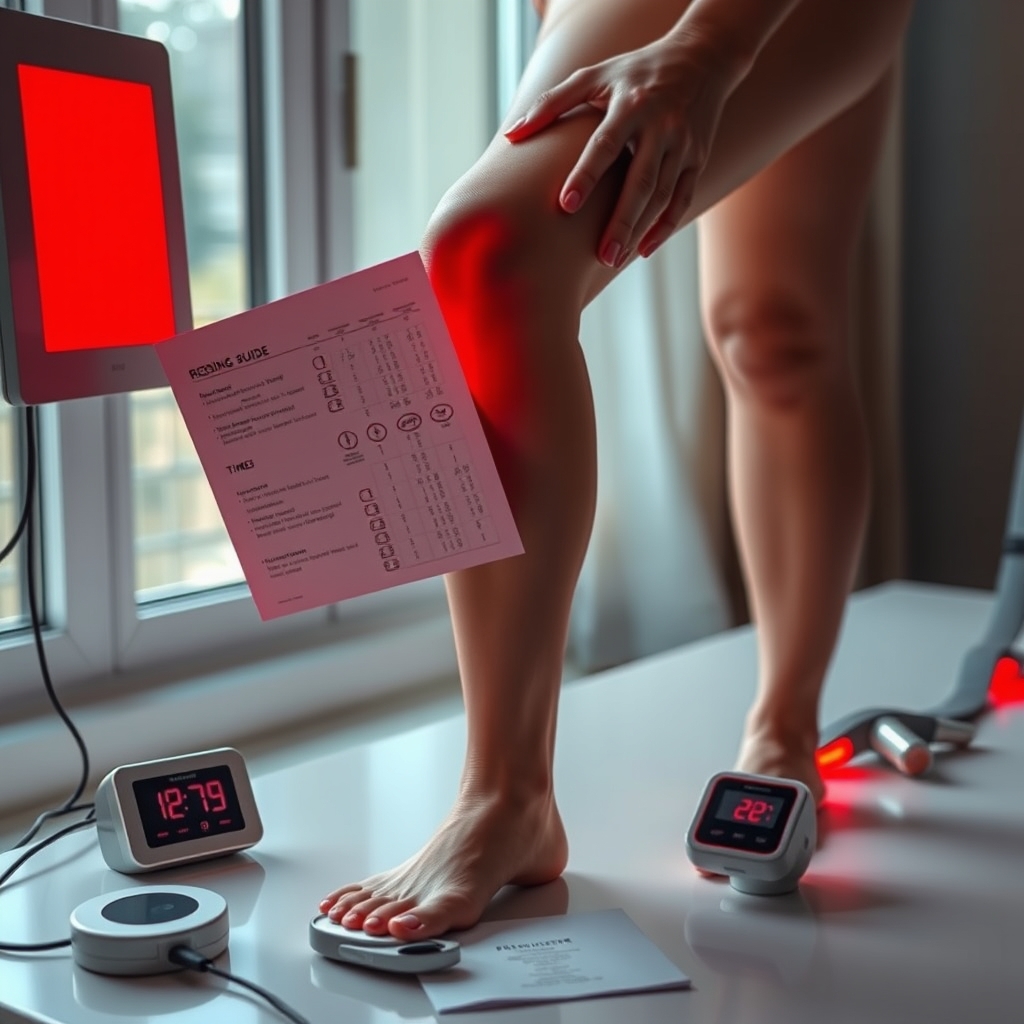
Want more ways to maximize effectiveness? Find panel and strap comparison advice in our detailed red light therapy device reviews. If you’re considering red light therapy for back pain, wearable options or belts may offer better placement and coverage—get specifics in our red light therapy belt guide.
Technical specs that determine effectiveness (how to read a device spec sheet)
Linda and buyers like her must become detail-oriented when choosing an at-home device. Key specs you should always look for when considering red light therapy for knee pain or joint pain:
- Wavelengths: Clinical benefit is most established for red (630–660 nm) and near-infrared (810–850 nm). Devices offering both (“RL + nIR”) dominate recommendations (over 60%).
- Irradiance (“output”): Look for at least 30 mW/cm². Too low, and you’ll need much longer sessions—or won’t reach therapeutic energy at all.
- Energy delivered (“dose”): Expressed in Joules per cm² (J/cm²). The clinical goal is generally 5–10 J/cm² for joints (8–12 minutes at the above irradiance achieves this).
- Coverage & form factor: Panels, pads, and straps each have pros and cons for targeting knees, backs, or shoulders. Each needs good skin contact or positioning for consistent dose delivery.
- Power source: Plugged-in devices often offer more consistent output. Battery-powered devices are portable but may lose brightness or require frequent charging.
Example: The Kineon Move+ Pro LED and Laser ($420) uses both LED and laser to achieve better penetration and comes in a strap that fits around the knee or can be adapted for the back (see clinician review).
Check for manufacturers that supply independent third-party output reports and clear irradiance numbers. If a device only specifies “wavelengths” but hides output, it’s a red flag.
Want help interpreting specs? See our worked examples and buying tips in our FDA cleared red light therapy device guide.
Practical treatment protocols — real home dosing and realistic expectations
How do you actually use red light therapy for pain relief at home—and what’s a realistic outcome timeline?
- Session length: 8–12 minutes per treatment site (i.e., per knee, back patch, or joint).
- Frequency: 3–5 sessions per week. Benefits build over several weeks but drop off if you stop.
- Timeline for relief: Most studies show pain relief starts within one or two weeks—maximum effect at 4–8 weeks with continued sessions.
- Tracking progress: Use a weekly pain log or a scoring app (scale of 0–10) and note ability to walk, sleep, or complete daily tasks.
- How to dose: Multiply the device’s output (mW/cm²) by the number of minutes. Example: a device with 30 mW/cm² output used for 10 minutes delivers about 18 J/cm²—more than enough for most home use, as clinical benefit usually occurs in the 5–12 J/cm² range.
Simple Dosing Calculator:
J/cm² = (irradiance in mW/cm² x minutes x 60) / 1000
Example: 30 mW/cm² x 10 minutes x 60 = 18,000 ÷ 1000 = 18 J/cm²
Set a schedule and stick to it—results often vanish after a week or two off the protocol. See more clinic-aligned dosing and device fit guidelines in our photobiomodulation device guide.
How to choose an at-home device (buyer’s checklist)
Quick Checklist for Red Light Therapy Device Shopping
- Verified wavelengths: 630–660 nm (red) and 810–850 nm (near-infrared)
- Irradiance: ≥30 mW/cm² minimum (ideally with third-party verification)
- Session timer or auto shutoff for safety and dosing
- Device form matches your target (panel for broad areas, strap/pad for joints)
- Warranty (12+ months) and clear customer service contact
- Power source fits your usage: plug-in if possible
- HSA/FSA eligible? Look for “HSA approved” or request a letter of medical necessity (see our HSA guide)
- Real independent device reviews (see our device reviews)
Avoid “max power” hype; what matters most is proven wavelengths, output, and a design you can use consistently. Many devices under $1,000 (like Kineon Move+ Pro at $420) meet basic specs and are realistic starting points when verified (source).
Compare and contrast more device options—especially for red light therapy for knee pain—at our portable device guide.
Real-world user problems and step-by-step troubleshooting
Even after picking the right device, many users hit snags that lead to wasted time or frustration. Here are common problems and how to fix them:
- Device seems weaker/loses effect: Check device output with a phone camera or inexpensive radiometer. If LEDs look dim, contact support about warranty. Avoid “double-treating”—doing multiple consecutive sessions in the same area can cause irritation.
- Pain returns quickly: Stick to the 3–5 times per week schedule. Skipping sessions leads to rapid loss of benefit for chronic pain conditions.
- Skin irritation or overheating: Ensure the device is at the correct distance (usually 0–5 cm; check manual), and avoid using two devices on top of each other.
- Placement issues (knees/back): Use mirrors, ask for help, or choose straps/pads for hard-to-position areas. Placement templates for joints are available in our guides for back and knee.
- Battery rapidly drains: Replace or use a plug-in model for multi-joint treatment. Devices lose effectiveness as batteries degrade over time.
Costs, insurance, and long-term cost of ownership
Price bands vary by spec, size, and brand:
- Entry-level: $150–$400 (usually pads, small panels, or targeted straps)
- Mid-range: $400–$900 (more coverage or combo LED/laser)
- Premium: $1000+ (large panels, professional-grade output)
Example: Kineon Move+ Pro LED and Laser retails at $420 and is a popular knee or back pick. Replacement costs (pads, batteries) may be needed after 1–2 years. Some models are labeled “HSA approved”; you may use HSA/FSA funds with a letter of medical necessity (learn how in our 2024 HSA guide).
Compared to clinic visits ($50–$200/session, not always covered by insurance), home use pays for itself after 2–6 months of frequent use—but device durability and warranty are essential cost factors. See our panel comparison guide for more cost-per-session tips.
Safety, side effects, contraindications, and long-term considerations
For most users, red light therapy for pain relief is safe—when used as directed. However, keep these essential tips in mind:
- Possible side effects: Mild skin redness, sensation of warmth, minor swelling (typically resolves on its own). Overuse (double sessions, extra-long exposure) increases risk.
- Eye protection: Always use Eye protection during facial or head treatments. Never look directly at active LEDs or lasers.
- Medications and conditions: If you take photosensitizing drugs (like some antibiotics) or have active cancer in the treatment area, do not use without explicit physician approval. PBM may change cellular activity—research shows anti-inflammatory cytokine modulation (source).
- Unknowns: Long-term (10+ years) effects are still being studied, but so far, the low outputs used in evidence-based devices appear safe with regular monitoring.
Top 3 sub-topics competitors often miss (and how we’ll cover them)
1. Verifying device output, and translating specs to everyday dosing: We’ll break down how to ask vendors for third-party irradiance reports, use a kilolux or radiometer for quick checks, and work through a live dose calculation (see our calculator above).
2. Joint-specific placement and dosing templates: Rather than generic “shine on knee,” we’ll map templates for knee, low back, and shoulder placement—plus, we’ll show why straps beat panels for curved joints and why over-treating can backfire.
3. Device durability, maintenance, and lifetime cost: We’ll show simple home tests for dimming LEDs, what to expect as batteries age, warranty considerations, and how to estimate total cost of ownership versus a few months of clinic sessions.
Genuine, reproducible pain relief from infrared light therapy for joint pain hinges on these overlooked factors. Review our device lifetime tips for advanced users.

Conclusion
The reality is clear: red light therapy for pain relief works—when you match clinical protocols and specs, stick to consistent sessions, and troubleshoot quickly if results fade. Home units can’t always match the punch of clinical systems, but with the right device and dosing, results can approach what the latest research shows for arthritis and chronic joint pain.
Ready to choose your device with confidence? Bookmark this guide, track your results, and revisit our buyer’s guides before making your next purchase. For ongoing updates and expert-tested protocols, explore our in-depth reviews and join the conversation about evidence-based red and infrared therapies.
FAQ
Does red light therapy work for arthritis or knee pain at home?
Yes, but only when the device delivers adequate output (≥30 mW/cm²) at proven wavelengths and sessions are kept regular (3–5 per week). Most underpowered consumer devices underperform—verify specs and placement carefully.
How soon will I notice pain relief with red or infrared light therapy?
Most users feel some relief in the first week. Maximum benefit is usually seen after 4–8 weeks of consistent use, and results drop off within days to weeks if you stop.
Are red light therapy devices covered by insurance or HSA/FSA?
Some devices are HSA/FSA-eligible with a letter of medical necessity; most insurers do not cover device costs but may reimburse for related therapy sessions. See our HSA/FSA guide for step-by-step tips.
What are the side effects or safety concerns?
Mild skin irritation or sensations of heat may occur. Always use eye protection for facial treatments. Do not use over areas with active cancer or while taking photosensitizing medications unless cleared by a doctor.
How can I tell if my red light therapy device is working correctly?
Check that all LEDs are lighting by using your phone camera in a dark room. Ask the manufacturer for a current output spec; devices that dim or lose power over time will lose effectiveness—replace or repair if needed.
—