


Red light therapy for thyroid has drawn attention from patients with Hashimoto’s and hypothyroidism who are searching for ways to reduce thyroid antibodies, lower medication needs, and slow autoimmune progression. But does the science support its use, and what should you actually expect if you’re considering neck-targeted photobiomodulation (RLT/PBM)? This guide provides a direct, patient-focused analysis based on clinical trials—not hype.
Key Takeaways
- Multiple controlled trials show RLT can lower thyroid autoantibodies (anti‑TPO drops 30–50%) and may mildly improve thyroid hormone levels in patients with Hashimoto’s/hypothyroidism.
- Dosage, device choice, and results vary between studies. Most participants are women with chronic autoimmune hypothyroidism; not everyone responds.
- Safety profile is favorable in the short term, but long-term risks and best candidate criteria are not fully defined. Always discuss with your endocrinologist and monitor labs if considering RLT.
- Executive summary — what the science actually shows
- Step-by-step guide: how to vet and discuss RLT for thyroid
- Advanced analysis & common pitfalls
- Conclusion: what patients should know
- FAQ
Executive summary — what the science actually shows
Evidence for red light therapy for thyroid comes from at least eight clinical studies (2010–2025, n≈30 to 120) evaluating photobiomodulation on the neck in adults with autoimmune thyroiditis or hypothyroidism. These trials include pilot studies, randomized controlled trials, and long-term (up to 6 years) follow-up cohorts. Studies consistently report that neck-targeted PBM therapy lowers anti-thyroid antibody levels (especially anti-TPO, typically 30–50% reductions), and modestly improves thyroid hormone profiles. This includes lowering TSH by ~15–25%, boosting free T4 and T3, and reducing levothyroxine (LT4) needs for some patients. Heterogeneity in dosimetry, device types, and clinical protocols limits generalization, and no major international regulatory body has issued a formal approval for RLT in thyroid disease. However, the consistent direction of effect, paired with generally favorable safety reports (no significant parathyroid issues and very limited adverse events), makes it a plausible option—especially for motivated patients seeking adjunctive, non-pharmacological support. Key evidence comes from studies by Höfling et al., Berisha-Muharremi et al., and systematic reviews covering Hashimoto’s cohorts and hypothyroidism management (see review).
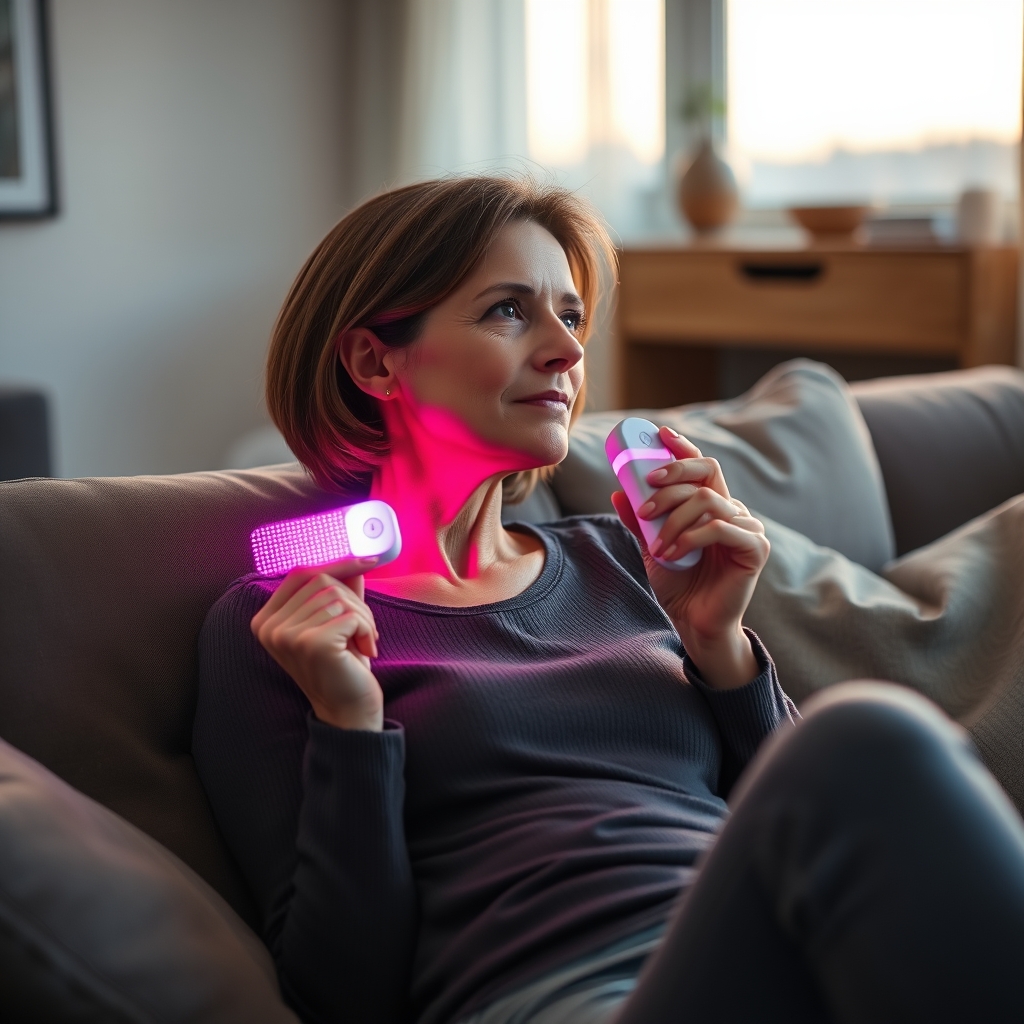
Step-by-step guide: how to vet and discuss RLT for thyroid
For patients with Hashimoto’s or primary hypothyroidism interested in pursuing RLT, here is a practical approach to judging plausibility, safety, and clinical relevance:
- Review your diagnosis and lab profile. Most trial participants were women aged 20–60 with chronic autoimmune hypothyroidism, confirmed by high anti-TPO/TG antibodies and abnormal TSH. Other causes of hypothyroidism, recent surgery, pregnancy, and non-autoimmune cases were usually excluded.
- Assess whether your clinical picture matches the studied populations. Stable LT4 use and persistently elevated antibodies are typical entry points for RLT in studies.
- Prepare to discuss RLT with your endocrinologist:
– Gather literature: Bring printouts or links to key studies (combined PBM + supplements trial, 12 month comparative study, the 2013 RCT).
– List your key goals: lowering anti-TPO, reducing LT4, or symptom relief.
– Ask about local device access: Home LED panels, low-level laser devices, and clinic-based PBM all differ in wavelength and dose. Ask for clinical validation and safety data for the specific model. - Set up baseline and follow-up lab testing. Best practice is to measure anti-TPO, TSH, free T4/T3, and clinical symptoms before, during, and after RLT. Doses were changed in up to 40% of trial patients; regular monitoring is essential to avoid over- or under-replacement.
- Understand expected results and realistic outcomes. Based on research, you can anticipate about a 30–50% anti-TPO reduction in responsive cases, with a small but statistically significant improvement in hormone levels. Some patients come off LT4 or reduce doses, but this is not universal.
- Inquire about session protocols and safety monitoring. Clinical studies report 2–3 sessions weekly for 2–4 weeks, with fluence ranging widely (38–108 J/cm² typical, up to ~707 J/cm² in one RCT). Most used point irradiation over the thyroid region. Know that protocols are not standardized.

For more on device choices, safety, and comparison, see our Red Light Therapy Device Guide or the Photobiomodulation Therapy Buying Guide.
Advanced analysis & common pitfalls
Despite promising results, patients and clinicians should be aware of these common pitfalls and controversy areas when considering red light therapy for thyroid problems:
- Trials are small, cohorts are variable. Most studies included 30–120 participants; numbers are low compared to drug trials. Long-term, multicenter research is lacking. One notable exception is the 6-year follow-up from Höfling et al., but such duration is rare.
- Dosimetry and device protocols are not standardized. The table below summarizes the variation across published trials:
Trial Sample Size Device/Wavelength Fluence (J/cm²) Sessions/Schedule Key Outcomes Höfling et al., 2010 30 Low-level laser, ~830nm 38–108 2x/week for 3 weeks ↓ anti-TPO 41%, ↑ FT4/T3, ↓ TSH, ↓ LT4 Höfling et al., 2013 RCT 43 830nm laser ~707 2x/week for 3 weeks ↓ anti-TPO, ↑ hormone levels Berisha-Muharremi et al., 2023/2025 74/98 820nm, 200mW NR (point-based, 20s/pt x8 pts) 2x/week, 3–4 weeks ↓ anti-TPO/TG/TSH, ↓ LT4, ↑ FT3/T4 Feasibility (PBM+supplements) 66 Details variable See full text Parallel to supplement-only ↓ antibodies, greater effect than supplements 12-month comparative 120 (60/arm) 820nm, PBM + supplements NR 12 months Anti-TPO normalization: from 8% to 16% - Access and regulatory approval are not globally uniform. Clinical trial registry NCT06735040 is ongoing (see trial). FDA/CE approval for at-home thyroid PBM devices is generally lacking as of 2024. For device validation tips, see FDA Cleared Red Light Devices.
- Placebo and supplement controls matter. Most studies compare RLT to placebo or regular supplementation. In multiple arms, RLT was superior to supplements alone for anti-TPO reduction. Pair interventions only under supervision.
- Not everyone responds; symptom relief is variable. While ~30–50% drops in antibodies are described, only a minority have complete normalization. Hormone improvements may not translate to dramatic symptom resolution.
- Potential risks and gaps: Adverse events are rare in published trials. However, concern for misapplied dosimetry, poor device quality, or use in excluded populations (children, pregnancy, multinodular goiter, etc) remains. No study was designed to examine cancer risk.
- Cost and insurance: No consolidated average cost is published. RLT for thyroid is not universally HSA/FSA eligible; guidance is evolving (read HSA eligibility guide).
Read more about broader evidence on near infrared light therapy in our Near Infrared Light Therapy Guide.

Conclusion: what patients should know
In summary, clinical trials show that red light therapy for thyroid—mainly using near infrared photobiomodulation over the neck—reliably lowers anti-TPO antibodies by 30–50% and may mildly improve thyroid hormones in Hashimoto’s and hypothyroid adults. Most responders are women with chronic autoimmune thyroiditis. Dosage and protocols are not standardized, and long-term safety, ideal device parameters, and best patient selection are still being researched. Before you try RLT, talk to your endocrinologist, insist on clinical-grade monitoring, and do not discontinue medication unless your labs support it. Set expectations for modest lab improvement—not a cure.
Ready to discuss or try RLT? Print this article, summarize your goals, and have a focused, evidence-based conversation with your endocrine specialist. For even more tips, see related guides on red light therapy pain relief and RLT for gut health.
FAQ
Does red light therapy reduce thyroid antibodies in Hashimoto’s?
Multiple controlled trials and systematic reviews show that red light therapy (photobiomodulation) can reduce anti-TPO antibody levels by approximately 30–50% in chronic autoimmune thyroiditis. However, not all patients achieve normalization, and results vary across studies (source).
Can red light therapy replace levothyroxine or thyroid hormone medication?
No, red light therapy is not a replacement for prescription thyroid drugs. Some trials show that up to 40% of treated patients reduced their medication dose (by 20–30%), but most remained on LT4. Always adjust doses under medical supervision.
Is red light therapy for thyroid safe?
Trials report few to no major adverse events. No studies found changes in parathyroid function or serious complications. Long-term risks remain unknown. Poor device quality, wrong dosage, or use in excluded groups could create problems, so expert oversight is essential.
What is the recommended device or dosage for thyroid RLT?
No universal protocol exists. Most trials used clinic lasers (820–830nm, fluence 38–108 J/cm², brief point irradiation, 2x/week for 3 weeks). Device quality and dosimetry matter – don’t assume all home lights are equivalent. For more on choosing safe devices, see our panel guide.
Can I use red light therapy for thyroid at home?
At-home use is being explored but is not yet standardized. Device specs and safety data are critical. Ask about device validation, and request regular lab checks. Home RLT devices should be used with input from your healthcare provider.